






 DARK

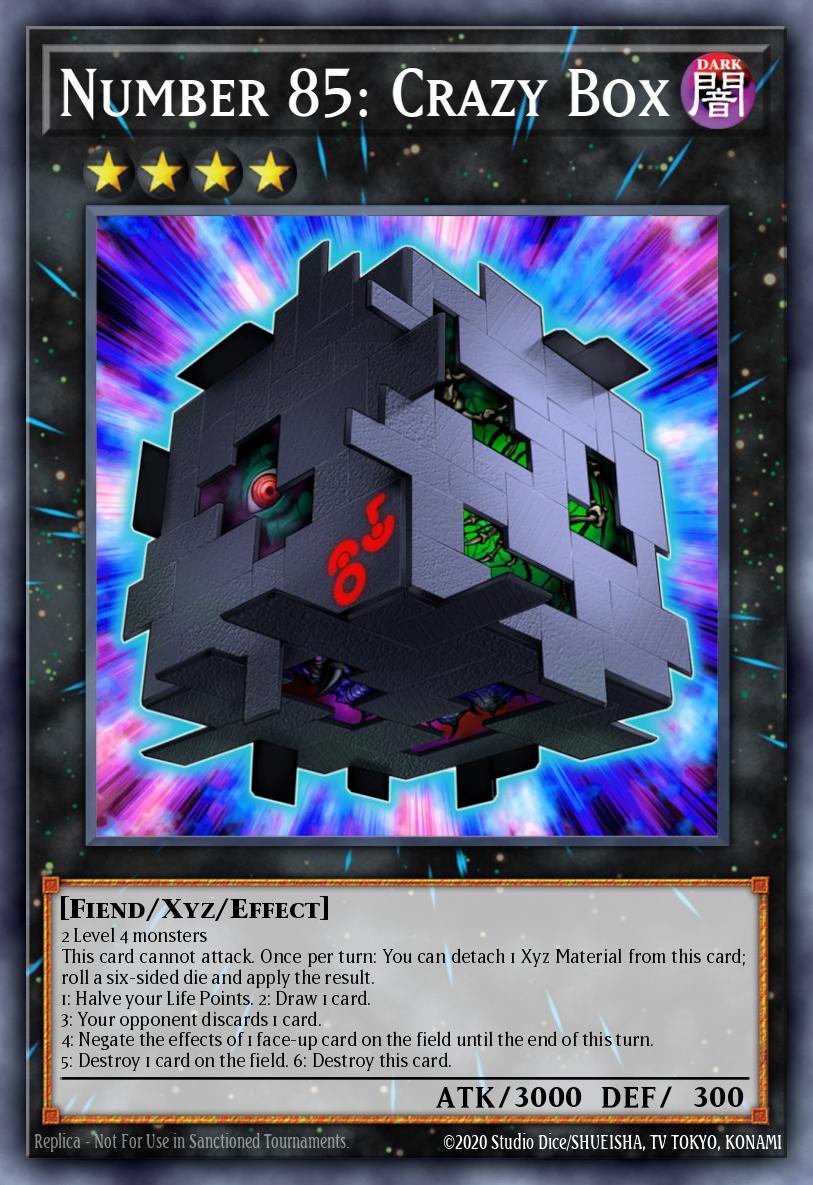
Number 85: Crazy Box
ATK:
3000
DEF:
300
View:
4186
2 Level 4 monsters This card cannot attack. Once per turn: You can detach 1 Xyz Material from this card; roll a six-sided die and apply the result. 1: Halve your Life Points. 2: Draw 1 card. 3: Your opponent discards 1 card. 4: Negate the effects of 1 face-up card on the field until the end of this turn. 5: Destroy 1 card on the field. 6: Destroy this card.
Number 85: Crazy Box — Power Evaluation
Final Score: 44 ± 6 · Confidence: Medium
- Intrinsic: 51 · Deck: 47 · Meta: provisional
- Primary role: Removal / Negation · Secondary: Utility
Why it scores here
Number 85: Crazy Box is a random-outcome utility card that provides selective removal, soft negation, or hand disruption through a d6 roll mechanic. While it appears in 287 decks across 90 distinct archetypes (primarily control-focused homes like Labrynth and Traptrix), the severe randomness of its effect prevents reliable synergy with combo lines, and zero recorded combo appearances confirm it functions as a standalone tech rather than a combo driver. The card's 3000 ATK and cannot-attack restriction mean it is valued for its effect flexibility, not as a threat, and its expected resource economy is slightly negative due to the self-harm and self-destruction outcomes. It is moderately accessible in Level 4-dense decks and survives multiple turns as board control utility, but the unpredictability of its payoff and lack of deck synergy place it solidly in the mid-tier power range.
Axis scores
| Axis | Score | Evidence |
|---|---|---|
| Accessibility | 65 | Accessible in 287 decks with 90 distinct archetypes through natural Level 4 access, but requires exactly 2 Level 4 monsters, limiting universal summonability. (observed) |
| Combo & Conversion | 18 | Zero recorded combo appearances and no combo synergy data confirm it does not reliably extend combos; randomness prevents integration into combo chains. (verified) |
| Resource Economy | 35 | D6 roll averages slightly negative resource return across six outcomes (self-harm roll 1, draw roll 2, discard roll 3, negate roll 4, destroy roll 5, self-destruct roll 6 yields ~−0.5 net). (inferred) |
| Effect & Interaction | 45 | Rolls provide soft negation (roll 4: effect negate), removal (roll 5: destroy 1 card), and hand disruption (roll 3: opponent discard), but all are random and occur at only ~1/6 probability per outcome. (verified) |
| Material Utility | 58 | Rank 4 XYZ body with 3000 ATK can serve as overlay material for other Rank 4 plays (e.g., Number 101, Abyss Dweller) and functions as a reasonable beater when blanked. (inferred) |
| Resilience & Flexibility | 52 | Survives multiple turns with 2 XYZ materials and once-per-turn activation; cannot attack but remains as board presence; generates value slowly across turns. (verified) |
| Deck-Building Efficiency | 60 | Moderate deck cost (requires 2 Level 4 monsters); 1.25 average copies per deck and 90 archetype spread suggest mild tech status rather than core inclusion. (observed) |
Calculation
Weight profile: Primary role: Removal / Negation. Intrinsic ≈ 51, Deck ≈ 47, Meta = provisional. Modifiers: Randomness penalty (-3); Cannot-attack restriction (-1). Final formula: 0.40*Intrinsic + 0.60*Deck
Strengths
- Flexible effect options (removal, negation, discard, draw) provide utility across multiple game states and answers
- Accessible in Level 4-dense archetypes (Labrynth 22 decks, Traptrix 18, Artifact 14, Runick 14 show consistent inclusion)
- Moderate body (3000 ATK) useful as material for Rank 4 overlays and as residual board threat
- Broad archetype portability (90 distinct homes) suggests it slots cleanly into control strategies across many themes
- Survives multiple turns with XYZ material pool; no once-per-duel restriction allows repeated use over the game
Weaknesses
- D6 roll randomness makes outcome unreliable; cannot guarantee the effect you need in any given turn
- Cannot attack severely limits ability to press tempo or threaten life total damage
- Zero combo appearances confirm no synergy with modern combo-driven strategies; purely a standalone utility tool
- Expected resource economy slightly negative due to self-harm (roll 1) and self-destruction (roll 6) outcomes
- Soft negation (roll 4) does not destroy threats, limiting interaction quality against permanent effects
- Slow effect generation (once-per-turn detach at one material per turn) compared to other control/removal tools
Counters / choke points
- Hand traps that negate XYZ summon (Ash Blossom & Joyous Spring, Maxx "C") prevent this card's appearance entirely
- Decks that ignore random effects (fast combo strategies) bypass this card's utility entirely
- Board wipes or targeted removal after the d6 roll resolves can invalidate the card's only action
- Multiple negates in a single turn (e.g., Solemn Judgment + another negate) stop effect resolution
Best use
Board control tech; random effect utility piece for decks that tolerate variance. Decks: Labrynth (7.7% of sample, primary home), Traptrix (6.3% of sample, secondary home), Artifact (4.9% of sample), Runick (4.9% of sample), Control and stall-focused strategies with Level 4 access.
Evidence & gaps
- Verified: Card text states once-per-turn d6 roll with six distinct outcomes (from card description); Cannot attack is a hard restriction stated in text (from description); Requires 2 Level 4 XYZ monsters for summon (XYZ rule); Appears in 287 decks across 90 distinct archetypes (from decks_evidence.total_decks, distinct_archetypes); Zero combo appearances recorded (from combos_evidence.appearances = 0); Top partners are control-focused: Solemn Judgment (33.8%), Skill Drain (27.9%), Pot of Duality (40.8%)
- Observed: 53% of running decks appear in gameplay type 4 (control-heavy metagame environment); 1.25 average copies per deck across the sample (slightly elevated from a typical 1-of tech); 29 decks run 3 copies versus 243 decks running 1 copy (indicates archetype-specific dedication in some homes); Four archetypes (Labrynth, Traptrix, Artifact, Runick) combined represent 44 of 287 decks (15.3% concentration)
- Inferred: Randomness (1/6 outcome per roll) severely limits reliability as a combo engine or interaction tool; Roll 2 (draw 1 card) at −1 material cost yields net 0 resources; strictly even trade; Roll 5 (destroy 1 card) is the most valuable outcome but occurs at only 16.7% probability per turn; Roll 4 (negate effects) is soft negation without destruction, weaker than permanent removal options; Expected resource economy across six rolls is slightly negative (roll 1 self-harm + roll 6 self-destruct outweigh draw roll); Portability across 90 archetypes indicates it is a tech inclusion valued for flexibility, not synergy depth; Control-heavy partner cards and 53% gameplay type 4 concentration suggest home primarily in go-second/stall shells
- Data gaps: No combos supplied — combo conversion and synergy inferred from card text only; zero recorded combo appearances definitively confirms lack of combo integration No guides supplied — cannot confirm community meta-role assessment or archetype-specific tech rationale from human sources No banlist token — assumed unlimited (3 copies legal in TCG, OCG, and MasterDuel formats) No usage statistics (StatisticsCard rows) — archetype inclusion percentages and typical copies inferred from 287-deck sample only, not historical averages No top-card ranking data — cannot confirm whether this card is considered viable at high competitive levels No explicit rulings on d6 roll timing — cannot confirm edge-case interactions (e.g., timing of material detach relative to roll resolution)